




Every month, the electricity bill at a pharmaceutical manufacturing facility in Telangana landed at around ₹92 lakh.
It was large, but not unexpected. The campus is extensive, Formulations manufacturing is energy-intensive by nature, and the facility has operated without interruption since 1989.
Most facilities in this position would accept that number and move on. The facility’s senior leadership did not.
The engineering team had been tracking the chiller plant closely. The 3 water-cooled screw chillers, a 400 TR, a 300 TR, and a 320 TR, were among the facility’s oldest heavy equipment, all installed between 2017 and 2018. They ran around the clock, drawing roughly 23.5% of the facility’s total electricity.
The chillers were performing. The question being asked was whether they were performing as efficiently as modern technology now allowed, and whether the gap, if any, could be quantified precisely enough to act on.
“Our team keeps this facility running at the highest standards. But we believed there was an opportunity to make the cooling system genuinely world-class in efficiency terms.” — Senior Vice President, Formulations Manufacturing Facility, Jadcherla, Telangana
The facility initiated a detailed HVAC energy audit with Energeia to find out what the numbers actually said.
The audit confirmed the instinct. At 1.195 kW/TR, the plant was operating 33% above modern efficiency benchmarks, and the gap was large enough to act on immediately.
Closing that gap required two things:
- Specialised technical expertise, and
- A financing structure that wouldn’t compete with capital already committed to pharmaceutical manufacturing.
The facility is found both in Energeia.
Under Energeia’s E-Chill pay-as-you-save model, Energeia funded, executed and guaranteed performance; the facility upgraded its entire chiller plant without committing a single rupee of upfront capital. The execution risk stayed with Energeia, and savings were verified against an independently measured baseline.
The result was a guaranteed, contracted outcome of energy and cost savings.
Key Stats
Annual Monetary Savings
Energy Savings Annually
CO₂ Emission Reduction
Customer Overview
A leading pharmaceutical manufacturer in Jadcherla, Telangana.
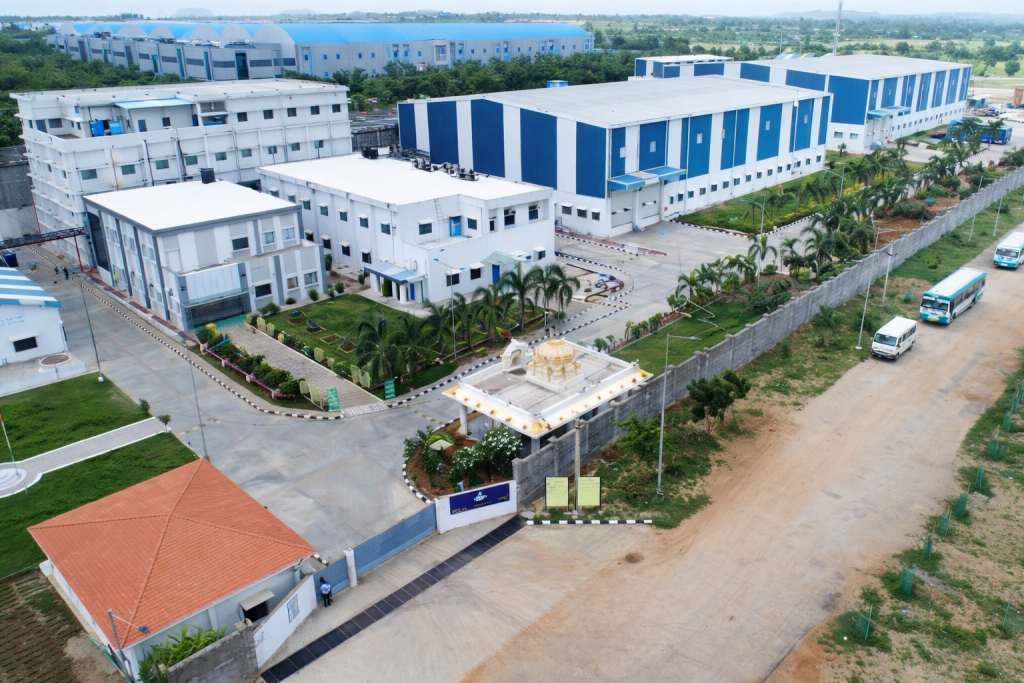
This client is a publicly listed pharmaceutical manufacturer with a 35-year operating history, USFDA-approved facilities, and an active export presence across regulated markets in the US, Europe, and Japan.
A facility of this nature operates without margin for error. Cooling is not background infrastructure; it is woven into every stage of production. The chiller plant runs around the clock, and so does the cost of running it.
- Location — Jadcherla, Telangana (India)
- Facility — API and formulations pharmaceutical manufacturing campus, operational since 1989
- Existing Chiller Plant —
- 1 × 400 TR water-cooled screw chiller (installed 2018)
- 1 × 300 TR water-cooled screw chiller (installed 2017)
- 1 × 320 TR water-cooled screw chiller (installed 2017)
- 3 cooling towers (inefficient, high condenser water temperatures)
- 4 primary pumps, 3 condenser pumps
The Challenge
Pharmaceutical manufacturing facilities operate under strict regulatory mandates, USFDA, WHO-GMP, and Schedule M under India’s Drugs and Cosmetics Act, all of which require continuous, precise environmental control across production and storage areas.
For such a facility, a cooling failure is not an operational inconvenience. It is a compliance event. Sustained temperature deviations can trigger batch rejection, product degradation, and, in serious cases, a regulatory hold, consequences that directly impact export certifications and production continuity.
The chiller plant met that standard. The challenge was not reliability; it was efficiency. The system was running, but no one had precisely measured what it was costing to run it.
SEC – The Golden Metric
The specific energy consumption of a chiller, measured in kW per ton of refrigeration, or kW/TR is the metric that answers that question definitively. A well-configured modern chiller plant achieves around 0.80–0.90 kW/TR under typical operating conditions, per BEE. The audit measured the plant at 1.195 kW/TR, confirming the gap between the existing fleet and what current technology could deliver.
The Hidden Inefficiencies in the Chiller Plant
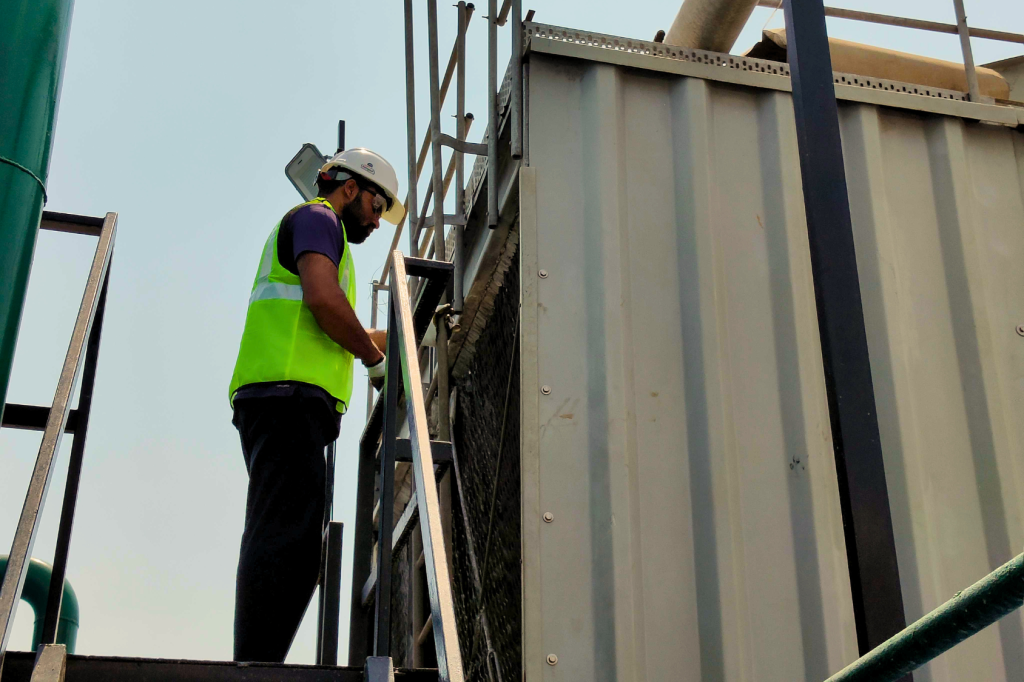
Energeia’s HVAC audit identified structural factors driving that gap.
- Ageing equipment reaching the limits of its efficiency curve
The 320 TR chiller, installed in 2017, had drifted furthest from its design efficiency and was identified in the audit as the weakest performer in the fleet. All three chillers were operating well past the point where fixed-speed screw technology delivers its best performance. The existing cooling towers compounded the picture further: running with high condenser water temperatures, they were adding avoidable heat rejection losses on top of the compressor inefficiency.
- A maintenance profile that signalled the right time to act
Older chillers and ageing pump infrastructure generate increasing maintenance demand as operating hours accumulate. The engineering team had been managing a growing volume of service interventions, unplanned breakdowns, rising spare parts procurement, and the operational overhead of keeping ageing equipment reliable in a facility where cooling is non-negotiable.
- Fixed-speed equipment and variable demand
All three chillers were fixed-speed screw machines. Fixed-speed chillers are designed for peak efficiency at or near full load. Pharmaceutical manufacturing plants, however, have inherently variable cooling demand across seasons. The audit’s load analysis showed the chiller plant running at 60–80% load for the majority of winter hours and through shoulder seasons.
Fixed-speed chillers are fundamentally inefficient at partial loads, continuing to draw near-full power even when demand drops. Per ASHRAE Standard 90.1, which mandates VFD controls on chillers above 75 tons precisely because of this part-load inefficiency, the 320 TR was the right candidate for replacement. It showed the largest gap between rated and measured efficiency across all load conditions.
The case for dedicated monitoring
What the audit made clear was that adding IoT-based flow meters and a live energy monitoring system would give the team a new level of control, real-time kW/TR data, continuous visibility into chiller sequencing, and the ability to detect performance trends the moment they emerge rather than inferring them from monthly bills. It would also create the verified, independent baseline that any credible savings calculation requires.
Structuring the investment correctly
Capital allocation priorities are rightly focused on pharmaceutical manufacturing capacity and regulatory compliance. The team recognized that acting on the chiller upgrade opportunity quickly mattered, and every month of delay was a month of recoverable savings foregone. The question was finding a financing structure that would let them move immediately without drawing on the CapEx earmarked for production. The ESPC model answered that directly: the upgrade would fund itself from its own savings, leaving manufacturing investment untouched.
The Solution
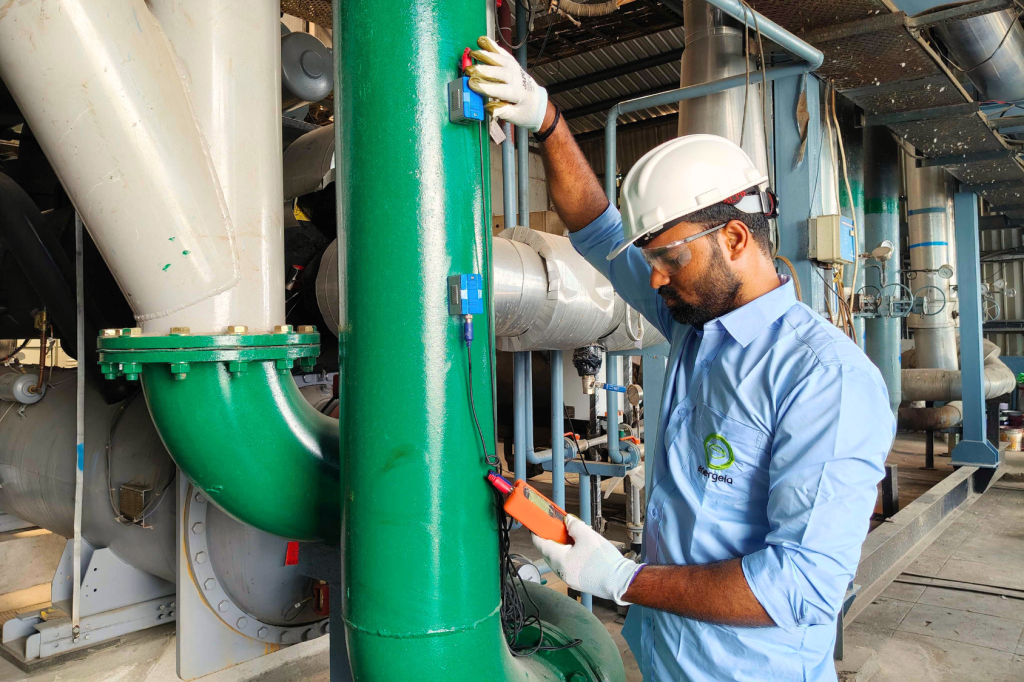
The audit confirmed the efficiency gap. The next question was not what to replace, but how to redesign the system to perform optimally under real operating conditions.
Energeia’s approach began with simulation, not equipment selection. Using the actual annual load profile across summer, monsoon, and winter, multiple system configurations were modelled to identify the most efficient combination for the plant’s real demand patterns.
The outcome was not a like-for-like replacement, but a complete system optimisation, executed under Energeia’s E-Chill pay-as-you-save model. The project was structured as an Energy Savings Performance Contract (ESPC), with Energeia funding 100% of the investment and taking full responsibility for performance and maintenance.
- High-Efficiency Chiller Upgrade
At the centre of the upgrade was the replacement of the underperforming 320 TR fixed-speed chiller with a 500 TR VFD water-cooled screw chiller. Unlike conventional systems that operate at a constant speed regardless of demand, the Variable Frequency Drive allows the compressor to adjust dynamically in real time.
This is particularly critical in a facility where cooling demand fluctuates throughout the year, and the system operates at partial load for extended periods.
By aligning output with actual demand, the new chiller significantly reduces energy consumption while increasing total installed capacity to 1,200 TR. This single intervention brought plant-level efficiency down from 1.195 to 0.8 kW/TR, delivering a 33% improvement.
- Cooling Tower Optimisation
The performance of the chiller system is closely tied to how effectively heat is rejected, making cooling tower efficiency a critical factor. The existing towers were replaced with energy-efficient low-approach cooling towers designed to deliver lower condenser water temperatures.
This directly reduces the load on the chiller compressors, particularly during high ambient conditions typical of Jadcherla’s climate. The result is a system that operates more efficiently under peak conditions while maintaining stable performance across seasons.
- High-Efficiency Pumping System
While chillers often receive the most attention, pumping systems account for a significant portion of total energy consumption. To address this, the chilled water and condenser water pumps were upgraded to high-efficiency units.
These systems are designed to optimise hydraulic performance while minimising electrical consumption. By reducing parasitic loads across the plant, the upgrade ensures that energy savings extend across the entire cooling system.
- Continuous Performance Maintenance (ATCS)
One of the most common reasons for declining chiller efficiency over time is fouling within heat exchangers. To prevent this, an Automatic Tube Cleaning System (ATCS) was installed as part of the upgrade. The system continuously removes deposits without requiring shutdowns, ensuring that heat transfer efficiency remains consistent over time. This not only sustains performance levels achieved at commissioning but also reduces the need for manual maintenance interventions.
- Water Softener System
Maintaining water quality is essential for the long-term reliability and efficiency of any cooling system. A Water Softener System was installed to ensure that the water circulating through the system meets the required quality standards. By preventing scaling, corrosion, and biological growth, the system protects critical components and extends equipment life, while also supporting consistent thermal performance.
- Real-Time Energy Intelligence (IoT EMS)
A key addition to the upgraded system was the deployment of an IoT-based Energy Monitoring System. By integrating flow meters, energy meters, and temperature sensors across the plant, the system provides real-time visibility into performance metrics such as kW/TR. This transforms the chiller plant from a well-operated system into a data-driven one, enabling precise tracking, early detection of inefficiencies, and transparent verification of energy savings.
- Integrated System Control & Sequencing
To ensure that all components work together as a single optimized system, a centralized control and sequencing strategy was implemented. Instead of operating independently, the chillers, pumps, and cooling towers now respond to a unified demand signal.
This allows the system to dynamically adjust to changing load conditions, ensuring optimal equipment utilization at all times, eliminating inefficiencies caused by manual or static operation.
Pay-as-You-Save Model Advantage
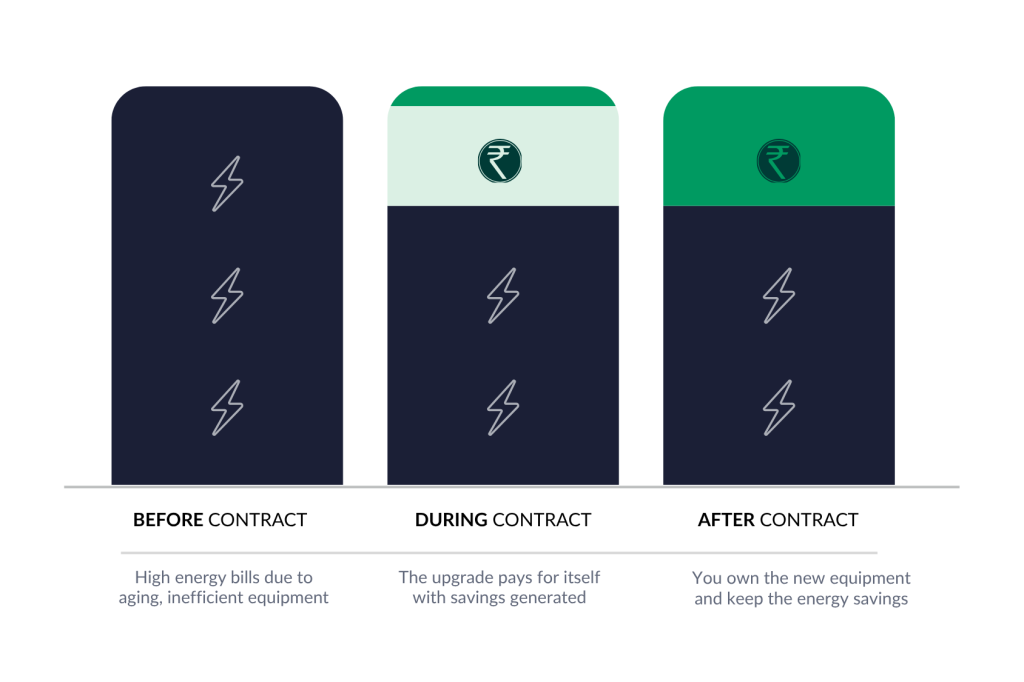
After identifying the gap, the focus shifted to how to act on it without diverting capital from core pharmaceutical operations or taking on performance risk.
Energeia’s E-Chill Pay-as-You-Save model addressed both. The entire upgrade was financed, installed, and commissioned by Energeia, with the new system brought online before the old unit was decommissioned, ensuring zero disruption to production.
Ownership of the system remains with Energeia during the contract period, which means performance risk shifts completely. If the system does not deliver the projected savings, the shortfall is Energeia’s responsibility, not the client’s.
Maintenance, servicing, and performance monitoring are also managed end-to-end by Energeia, ensuring that efficiency gains are sustained over time. At the end of the term, all assets are transferred to the client at no additional cost.
The result is a simple outcome: no upfront investment, immediate savings, and guaranteed performance, with ownership built over time.
Curious about the Pay-as-You-Save model? Learn more here.
Results
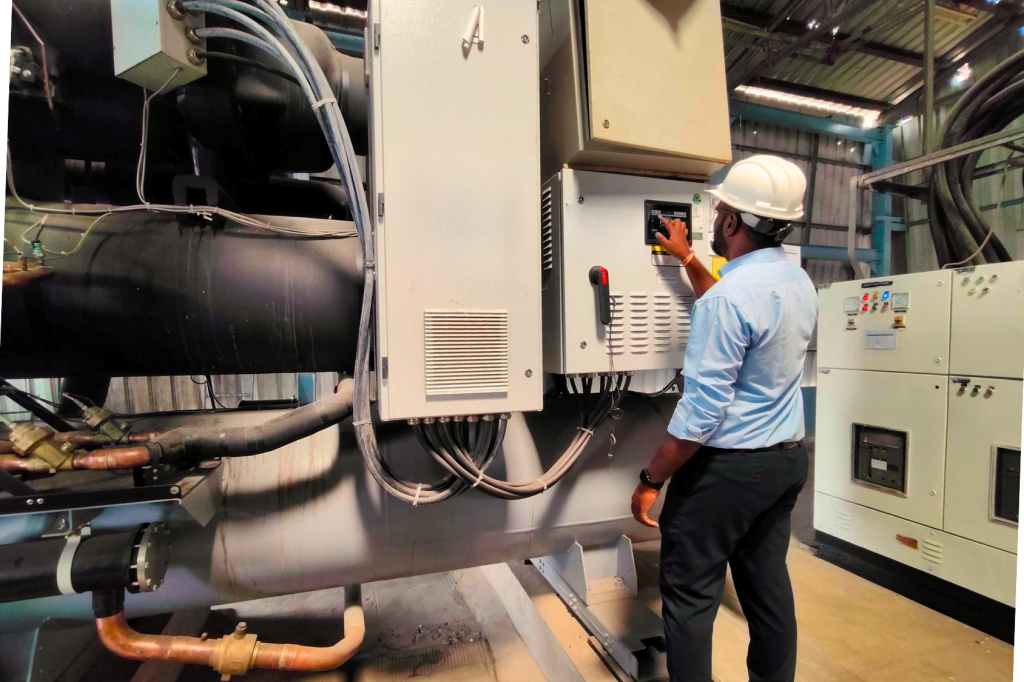
The new chiller system brought the facility’s plant-level specific energy consumption from 1.195 kW/TR to 0.80 kW/TR, a 33% efficiency improvement that directly translates into every line of the results below.
| Metric | Before (Old System) | After (New System) | Improvement |
|---|---|---|---|
| Plant Specific Energy Consumption | 1.195 kW/TR | 0.80 kW/TR | ↑ 33% More Efficient |
| Annual Chiller Plant Energy Use | 32,12,160 kWh | 21,52,147kWh | ↓ 10,60,013 kWh |
| Annual Chiller Energy Cost | ₹2.57 Crore | ₹1.72 Crore | ↓ ₹84.8Lakh Saved |
| Chiller Capacity | 1,020 TR (3 chillers) | 1,200 TR (incl. new 500 TR) | ↑ Better redundancy |
| Upfront Investment from Client | – | ₹0 (ESCO-funded) | ✓ Zero capex |
Key Takeaways
- If your air-cooled chiller operates above 1.1 kW/TR, or your water-cooled plant exceeds 0.75 kW/TR, you are likely paying more than necessary for cooling. The typical recovery potential is 20–30% of chiller electricity costs.
- Fixed-speed chillers running at partial load are the most common source of this waste. The combination of a fixed-speed base-load chiller with a VFD trim chiller is the most efficient architecture for facilities with variable cooling demand.
- IoT-based energy monitoring is what transforms a well-run chiller plant into a data-driven one. Real-time kW/TR tracking, continuous benchmarking, and automated performance alerts give engineering teams the visibility to catch degradation early and verify savings precisely. It is the upgrade that makes every subsequent intervention more defensible.
- The capex barrier is no longer a reason to defer action. Energeia’s pay-as-you-save model means the upgrade funds itself. The client’s capital stays in pharmaceutical manufacturing, where it belongs.
FAQ’s
At the facility, Energeia identified and delivered ₹84.8 lakh in annual chiller plant energy savings, a 33% reduction in system energy consumption. The chiller plant accounted for ~23.5% of the facility’s total electricity bill before the upgrade. For pharma plants running ageing water-cooled chillers at above 0.85kW/TR, the savings opportunity is typically material. A detailed audit quantifies it precisely.
kW/TR (kilowatts per ton of refrigeration) measures how much electricity a chiller plant uses to deliver one ton of cooling. Lower is better. Best-in-class for a modern VFD water-cooled screw chiller system is approximately 0.90 kW/TR at the plant level. The pharmaceutical plant was running at 1.195 kW/TR before the upgrade, 33% above target. After installation of the new 500 TR VFD chiller, the plant reached 0.80 kW/TR, saving 10,60,013 kWh annually.
VFD chillers are significantly more efficient at part-load conditions, and part-load is the norm for most pharmaceutical facilities, where cooling demand varies across shifts, seasons, and production schedules. Replacing the 320 TR fixed-speed chiller with a 500 TR VFD unit was the key intervention that dropped plant efficiency from 1.195 to 0.80 kW/TR. The right combination depends on actual demand profiles, which is why an audit before any upgrade decision is essential.
An ESCO (Energy Service Company) finances, installs, and maintains energy efficiency upgrades with no upfront investment from the facility. Under a pay-as-you-save model, the energy cost savings generated by post-implementation are split between the ESCO and the client over the contract period. In this case, Energeia funded the full project, and the client receives a percentage of the verified savings. All equipment transfers to the client at the end of the term.
No, if it is sequenced correctly. Energeia’s implementation approach ensures the new chiller is commissioned and verified as operational before the old unit is decommissioned, maintaining full cooling availability throughout. The 400 TR and 300 TR chillers continued running throughout the project, with the new 500 TR VFD chiller coming online first. Zero production downtime is a contractual commitment, not just a goal.