




Compressed air systems are among the largest hidden energy drains in manufacturing plants across India. Yet for most manufacturing plants across India, realising compressed air energy savings at scale remains a persistent challenge; systems run continuously, but without real-time visibility into where the losses actually are.
At this manufacturer’s Bangalore facility, 6 compressors ran around the clock. The plant engineer believed the system could be more efficient but lacked the data to prove it or act with confidence.
The setup included four 55 kW compressors and two 90 kW units, all ageing and running continuously. Air pressure held. Production didn’t stop. But every month, rising power bills indicated rising compressed-air energy costs.
Maintenance had become routine. During power cuts, compressors restarted in uncoordinated surges, causing voltage instability. The engineering team had a clear hypothesis: ageing equipment, inefficient load distribution, and no closed-loop control over restart sequencing.
“We had a good understanding of where the inefficiencies were coming from,”
– said the facility’s engineering head.
“What we didn’t have was the real-time instrumentation to quantify them precisely, and without that, any investment case we built would be based on estimates, not evidence.”
This is a common challenge across Indian manufacturing, not broken systems, but unmeasured ones.
Across plants, crores worth of equipment runs without clear insight into consumption, losses, or performance drift, allowing inefficiencies to compound quietly over time.
Recognizing that real-time compressed air monitoring and optimization required specialized expertise, the manufacturer brought in Energeia to measure and validate inefficiencies and implement data-driven fixes.
With Energeia’s pay-as-you-save financing model, the manufacturer was successfully able to make their compressed air system more efficient – without any upfront capital investment, shifting execution risk away from the plant. The result was a clear, data-backed pathway to measurable, verified energy savings.
Key Stats
Annual Monetary Savings
Energy Savings Annually
CO₂ Emission Reduction
Customer Overview
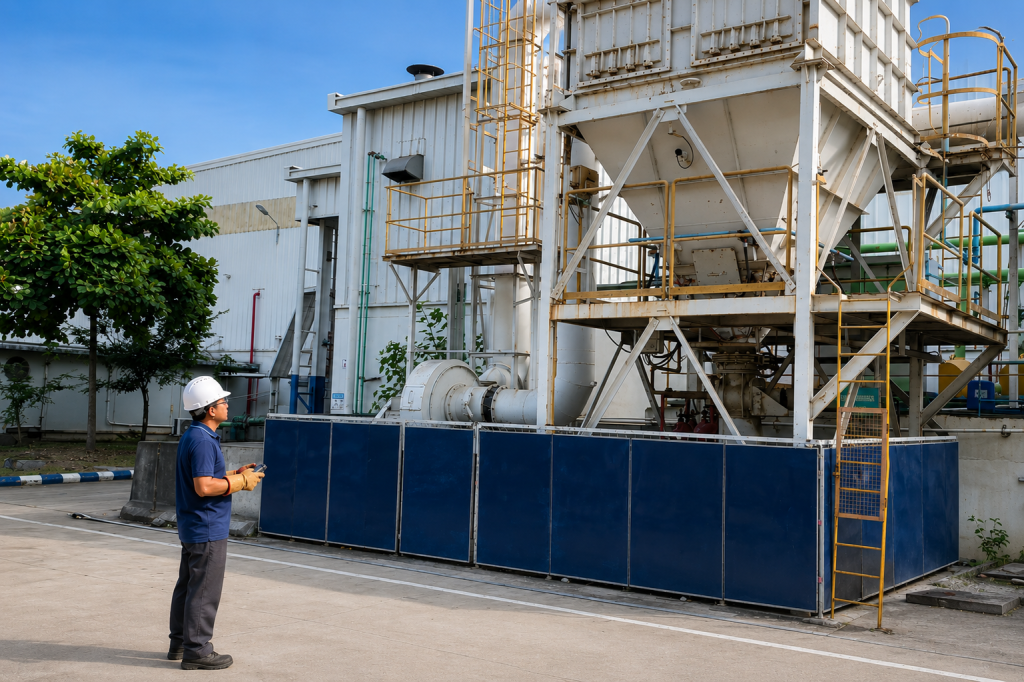
The client is a leading manufacturer of precision automotive components, supplying directly to automotive OEMs, a supply chain position that demands precision manufacturing at scale and leaves little room for operational inefficiency.
The Bangalore facility produces precision clutch components for the domestic and export markets. The plant runs a continuous production cycle, with compressed air as one of its most critical utilities, and for a facility of this scale, compressed air energy savings in manufacturing India translate directly into margin recovered on every unit produced.
- Location: Bangalore, Karnataka (India)
- Facility: Precision automotive components, clutch systems
- Existing Compressed Air System:
- 4 × GAE 55 A FF (55 kW fixed-speed compressors)
- 1 × GA 90 A FF (90 kW fixed-speed compressor)
- 1 × GA 90 VSD A FF (90 kW variable-speed compressor)
The Challenge
The Bangalore plant had significant untapped efficiency potential.
Why Compressed Air Optimization Is Important for Industries
Compressed air is the fourth utility in manufacturing, after electricity, gas, and water, and consistently the least understood. According to the Bureau of Energy Efficiency, compressed air systems account for 25–40% of total electricity consumption in a typical Indian manufacturing facility. The Lawrence Berkeley National Laboratory estimates that in most industrial compressed air systems, 20–30% of generated air is lost to leaks alone, waste that shows up nowhere except the electricity bill.
The Manufacturer’s Compressed Air Plant
The facility’s system consumes approximately 2.8 GWh of electricity annually. The specific power of the system (the standard measure of compressor efficiency, expressed in kW per CFM of air delivered) stood at 0.23 kW/CFM. Best-in-class benchmarks for a system of this configuration sit at 0.18 kW/CFM.
The gap between those two numbers represented a high, recoverable cost. And the reasons were structural.
- Equipment at the end of its efficiency curve. All 6 compressors were operating well past their designed efficiency peak. Fixed-speed compressors running at partial load are particularly costly: they draw near-full power whether the plant needs a full air supply or not.
- No structured monitoring system in place. There were no flow meters on the system. No monitoring. No way to know how much air was being produced, how much was reaching the point of use, or how much was being lost between the two. Without a baseline, there was no way to identify waste, prioritise interventions, or verify improvements.
This last point is where most industrial compressed air problems begin and end. The BEE’s guidelines, measurement and monitoring are prerequisites for any meaningful efficiency improvement, yet instrumentation remains among the most underinvested areas in Indian manufacturing.
The Solution
Energeia’s E-Air Pay-as-you-save Financing Model
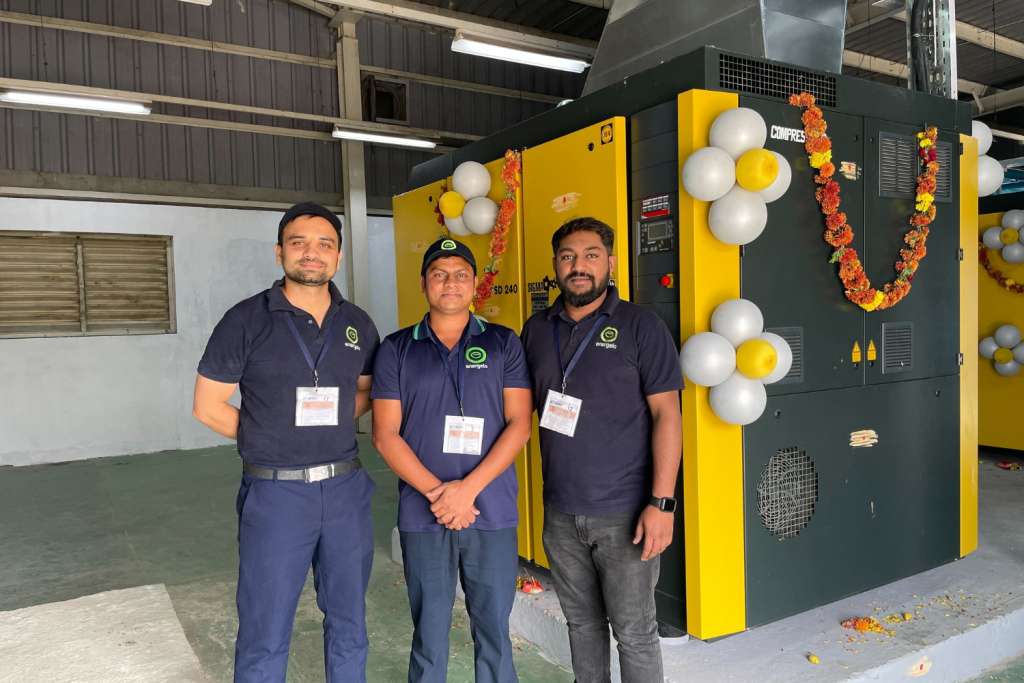
Most attempts at compressed air energy savings in Indian manufacturing follow a familiar pattern: a vendor walks in, recommends new equipment, and leaves the plant to figure out financing and performance risk on its own.
Energeia’s approach inverts that sequence entirely.
The audit came first.
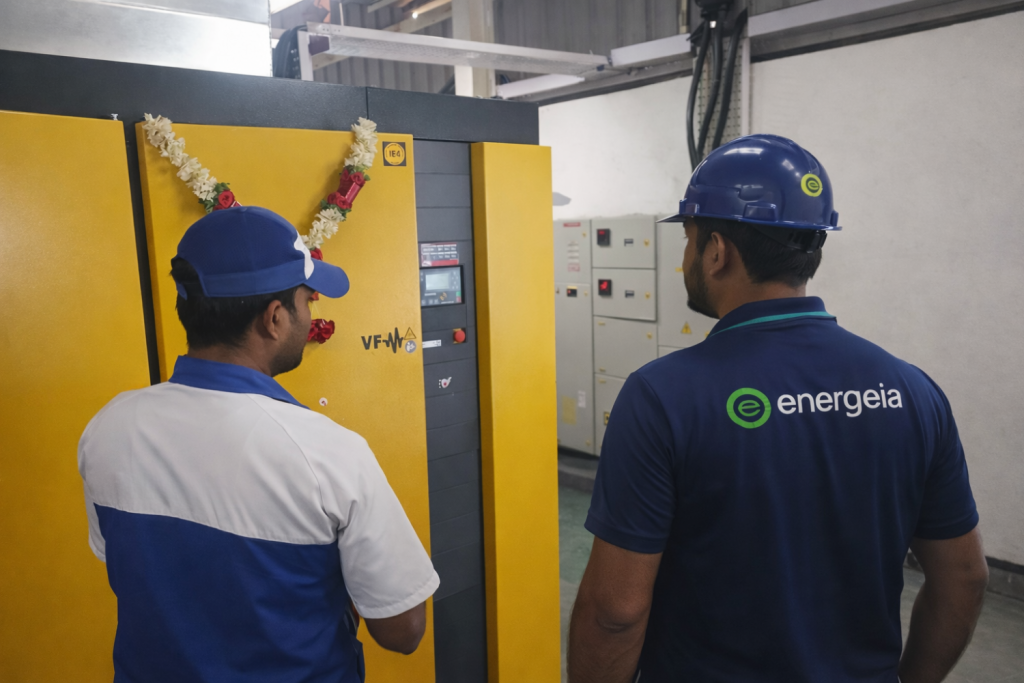
Energeia deployed IoT sensors across all 6 compressors for two weeks, capturing flow, pressure, power draw, and specific energy consumption 24/7. Not a snapshot. Not an estimate. A complete demand profile of the system as it actually behaved across production shifts, idle periods, and power restoration cycles.
The data confirmed what the plant had suspected and, for the first time, put precise numbers to it.
- System-wide specific power: 0.23 kW/CFM.
- Discharge pressures running consistently 0.5 bar above what production actually required.
- Load distribution uneven across the fleet, with individual compressors cycling inefficiently in the absence of any central coordination.
With a real demand profile in hand, Energeia ran computer simulations of multiple upgrade configurations, not against theoretical benchmarks, but against the plant’s actual air consumption pattern.
The question wasn’t which compressors were best-in-class in isolation. It was which combination will perform best against this plant’s specific load curve.
The answer was simpler than six compressors.
Step 1: Best-in-Class Compressor Replacement
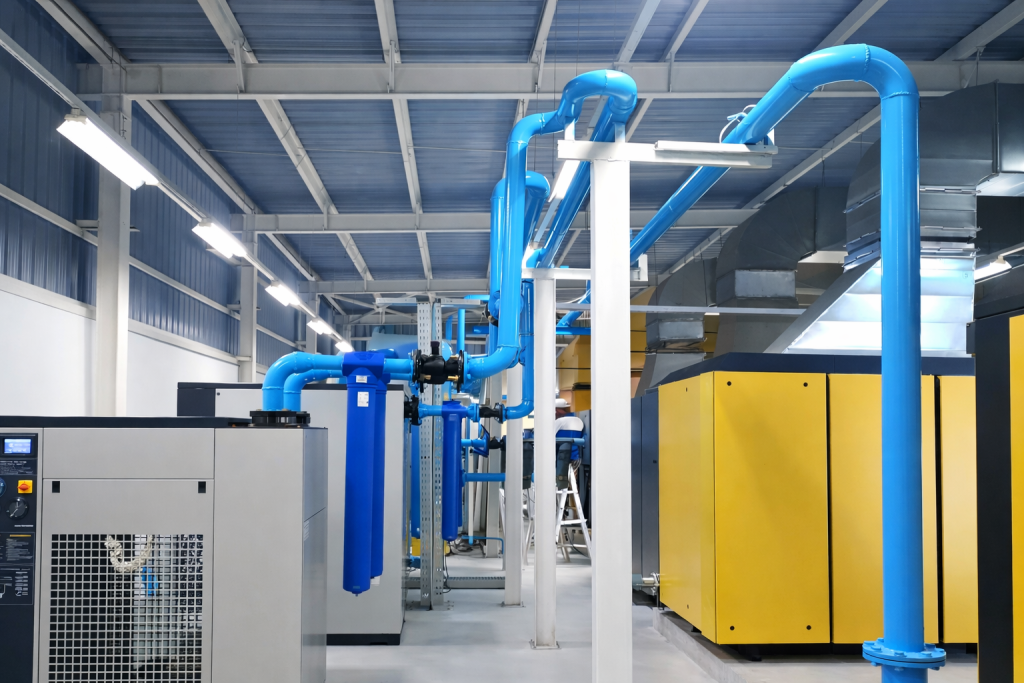
The existing fleet (four 55 kW fixed-speed units and two 90 kW machines) were replaced with one 132 kW fixed-speed and one 160 kW variable-speed compressor, selected for how they complement each other under variable demand.
- Fixed-speed 132 kW compressor: handles steady base load efficiently.
- VFD 160 kW compressor: modulates speed in real time to match fluctuating demand, drawing only the power the system actually needs at any given moment.
The result was immediate. Average system power dropped from 282 kW to 180 kW. Specific power improved from 0.23 to 0.18 kW/CFM, a 22% gain, closing the gap between where the system was and where best-in-class benchmarks had always sat.
Step 2: Pressure Optimisation
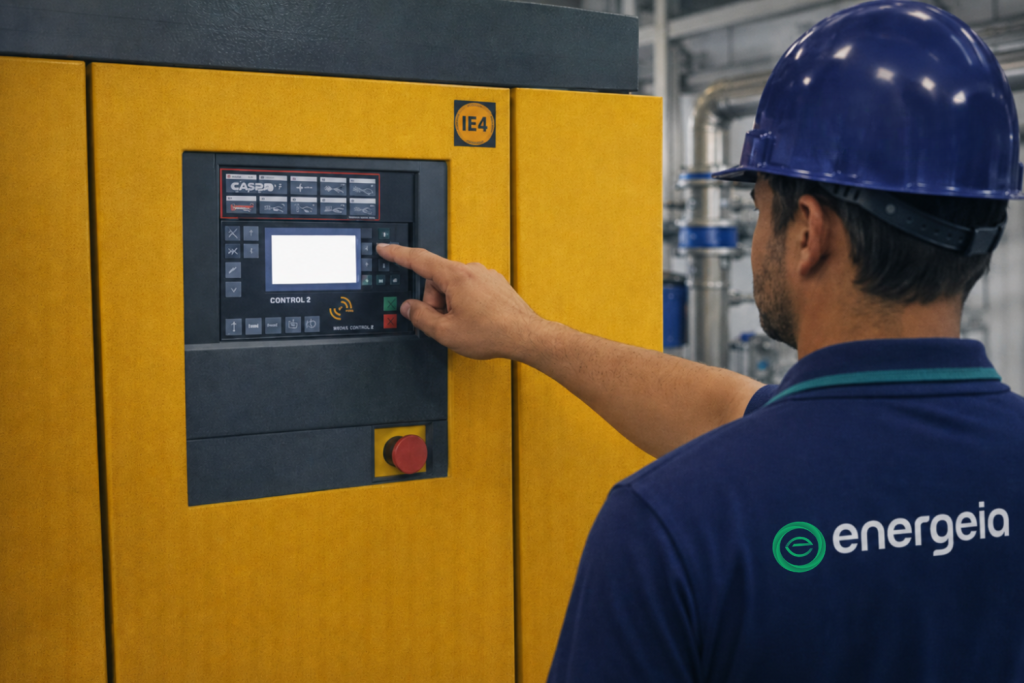
New compressors running without coordination can repeat the same inefficiencies as the old ones. To address this, both units were configured to operate as a single system responding to overall plant demand rather than functioning independently on their own sensors.
Alongside this, the system pressure set point was reduced by 0.5 bar. This single adjustment delivered an additional 3.5% in energy savings, with no change to production output or air quality at the point of use.
Unique Financing Structure: Pay-as-you-save ESCO Model
The entire intervention – equipment, installation, commissioning, and ongoing maintenance – is financed through Energeia’s Pay-as-you-save ESCO model. The client team needs to put in zero capital. The project pays for itself from the energy savings it generates, with Energeia guaranteeing system performance and covering full maintenance for the duration of the contract.
Pay-as-you-save Model
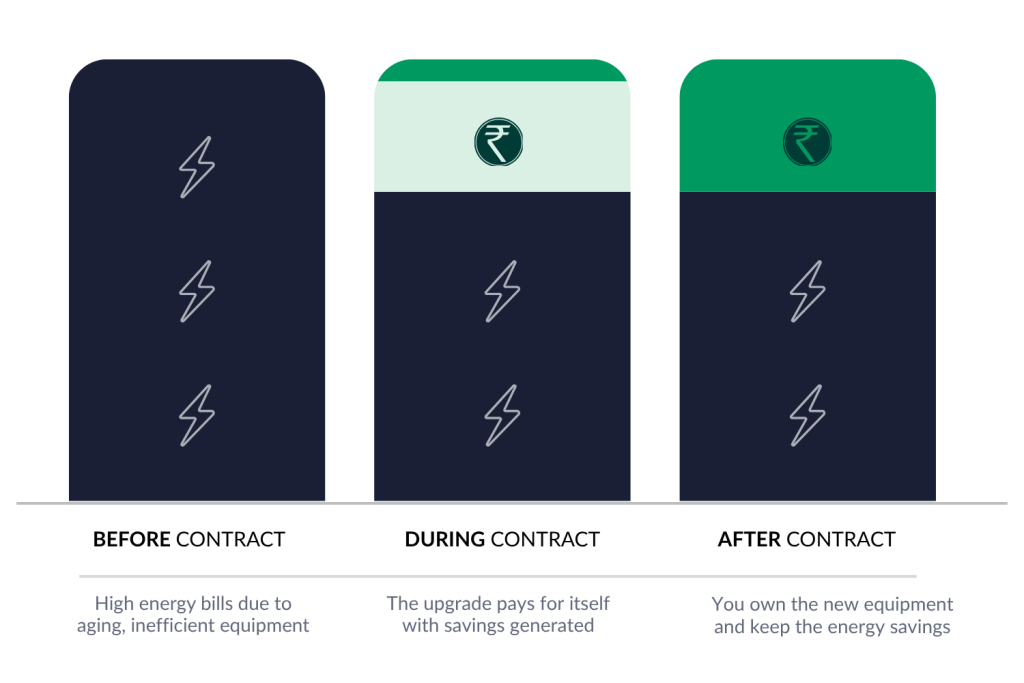
The compressed air system at the manufacturer’s Bangalore plant needed a complete overhaul. The question wasn’t whether to act; the audit had settled that. The question was who absorbs the risk of acting.
Under Energeia’s Pay-as-you-save model, the answer is straightforward: Energeia does.
- Energeia financed, installed, and commissioned the new two-compressor system from day one. The new equipment was brought online before the old fleet was decommissioned; production continued without interruption, with no gap between the old system going down and the new one coming up.
- Energeia owns the equipment for the duration of the contract. If the system underperforms against the guaranteed savings baseline, the shortfall is Energeia’s problem, not this manufacturer’s.
- Maintenance, servicing, and performance monitoring remain Energeia’s responsibility throughout.
Curious about the Pay-as-you-save Model? Learn more here.
Results
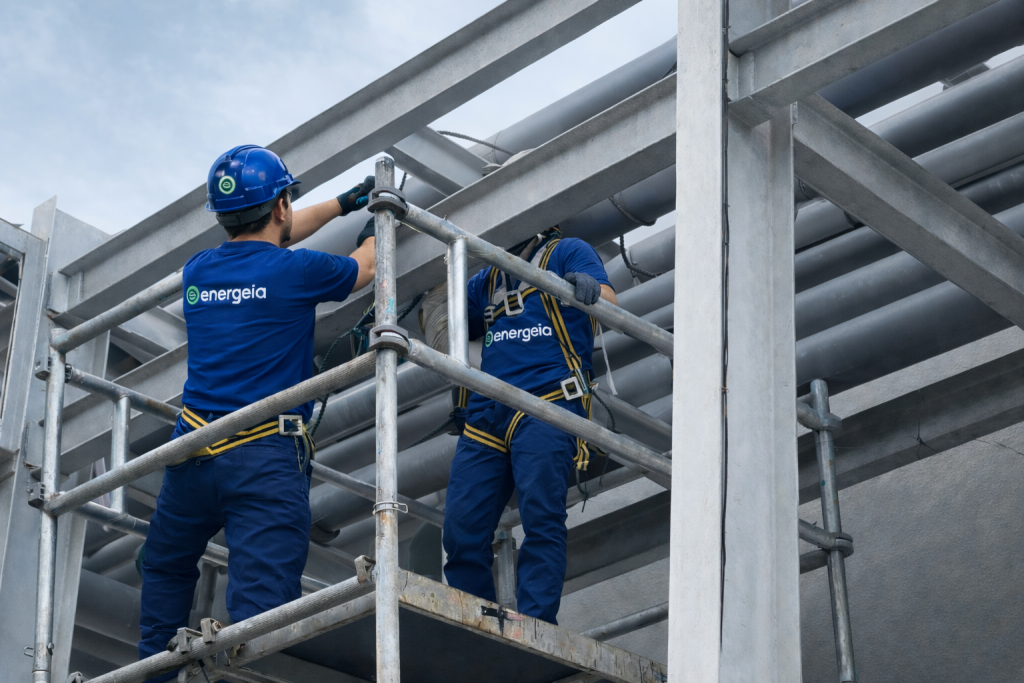
The engineering team now had exactly what they’d set out to get: complete, real-time visibility into every corner of their compressed air system.
- Two compressors replaced six.
- One controller replaced none.
The numbers that came back were not marginal.
| Metric | Before (Old System) | After (New System) | Improvement |
| System Specific Power | 0.23 kW/CFM | 0.18 kW/CFM | 22% More Efficient |
| Average Power Draw | ~282 kW | ~181 kW | 36% Reduction |
| Annual Energy Use | 28,00,000 kWh | 22,60,000 kWh | 5,40,000 kWh Saved |
| Discharge Pressure | 6.18 – 6.35 bar | 5.7 bar | Over-compression eliminated |
Like this manufacturer, you can achieve measurable compressed air energy savings for your manufacturing plant in India, without investing a single rupee upfront. Click here to learn how our E-Air model works.
Key Takeaways
Most manufacturing plants in India can achieve significant compressed air energy savings of 20–35% through system optimization, without capital investment.
- Measure compressed air systems before optimizing: Short-term audits reveal inefficiencies in power, pressure, and load distribution
- Track specific power (kW/CFM): Systems above 0.18 kW/CFM operate inefficiently and increase energy costs
- Optimize compressed air system design: A fixed-speed + VFD combination improves efficiency under variable demand
- Reduce compressed air pressure: Even a 0.5 bar reduction can deliver 3–5% energy savings
- Adopt zero-capex energy models: ESCO structures eliminate upfront investment and reduce financial risk
- Reduce emissions with energy efficiency: Compressed air optimization delivers measurable CO₂ reduction without additional capex
FAQ’s
Compressed air is one of the most energy-intensive utilities on the plant floor. According to the Bureau of Energy Efficiency, it typically accounts for 10% of total electricity consumption and can go up to 30% in automotive and precision manufacturing. At this facility, the compressed air system consumed 2.3 GWh. In most plants, this cost goes unnoticed because, without flow of metering and real-time monitoring, compressed air consumption remains hidden within overall electricity bills.
Specific power (kW/CFM) measures how much electricity is used to produce each unit of compressed air. It is the most critical efficiency metric for any system. Best-in-class performance is 0.18 kW/CFM at 6 bars, while the facility was operating at 0.23 kW/CFM before the project. A higher value directly translates to higher operating costs. Without tracking this metric, it is impossible to assess efficiency or identify improvement opportunities, making it a key number every plant team should monitor.
The most efficient systems use a combination of both. Fixed-speed compressors perform best at full load but waste power at partial loads, while VFD compressors adjust output to match real-time demand, reducing losses. At this plant, replacing six ageing compressors with a combination of 132 kW fixed speed and 160 kW VFD units reduced specific power by 22% and annual energy consumption by 5,39,239 kWh. The optimal setup depends on actual demand patterns, which is why a detailed system audit is essential before upgrading.
An ESCO (Energy Service Company) funds and implements efficiency upgrades with no upfront investment from the plant. Under a Pay-as-you-save ESCO savings model, the savings generated post-implementation are split between the ESCO and the plant over a defined contract period, typically 3 – 8 years. This removes capital constraints and financial risk for the plant. In this manufacturer’s case, the entire project was executed with zero upfront cost, with savings starting immediately after implementation.
Air leakage is one of the most common and overlooked inefficiencies in compressed air systems. Plants without flow metering and continuous monitoring typically cannot quantify these losses. A key indicator is over-compression, when system pressure is consistently higher than required. Leak detection surveys can identify problem areas, and even small leaks (e.g., a 3 mm hole) can lead to significant annual losses. At this facility, leakage was identified during the audit but excluded from savings estimates, indicating additional untapped potential.